
Introduction
When the SET project kicked off in early 2024, the appetite, knowledge, and available resources to promote green travel among universities and Erasmus+ students were less profound than they are today. Travelling sustainably to and from the mobility destination is no longer a niche aspiration or a footnote, but an integral part of what quality mobility should look like for higher education students and trainees.
One of the core problems the project aimed to address was the environmental awareness-action gap. Building on previous data from the Erasmus Goes Green and Green Erasmus projects, we found that higher education students do not need to be convinced about the benefits of ground travel; indeed, many are willing and committed to changing their daily habits to reduce their carbon footprint. Nonetheless, the real barriers are systemic: disproportionately higher costs compared to flying, fragmented booking systems, insufficient cross-border and long-distance journeys, and uncertainty or lack of trust continue to discourage a majority of participants from choosing rail over air transport.
For green travel to become the norm rather than the exception in Erasmus+, national and European actors and decision-makers must coordinate actions.
Overcoming the main barriers: financial, behavioural, and practical support
Students’ travel choices are largely influenced by costs, journey duration, information availability, and connectivity.
Costs
European education policies have included sustainability as a key objective in international mobility. However, considering that aviation, especially low-cost airlines, often offers fares up to 4 times cheaper than the same journey by train. Students, often on a low budget, will naturally choose the cheaper option. Although some extra factors may come into account when calculating the costs: having to pay for your transfer to the airport, at home and at the arrival destination, and above all paying expensive fees for your luggage. If you’re moving abroad for a long time, you might be travelling with a couple of suitcases to check in, which could easily add up to more than 100€. On the other hand, travelling by train comes with fewer baggage-related limitations or additional costs (most standard or 2nd class tickets include 2 pieces of luggage plus a handbag, but policies may vary between companies), and there is no need to pay for airport transfers as trains get you straight to city centres!
To help bridge this financial gap, the Erasmus+ programme has introduced a new Travel Grant scheme: when travelling sustainably, participants are entitled to a greater amount of money – amounts are calculated based on the distance. More details here:
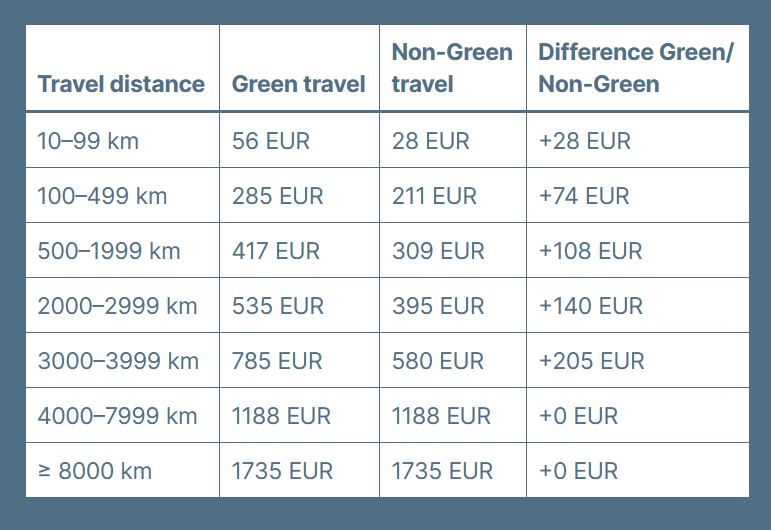
Source: https://erasmusbytrain.eu/plan-your-journey/
Journey duration
Of course, travelling by train for a full day might sound very long, boring, and inefficient. But if you’re going abroad for 6 months, will that one day really make a difference? Students who have experienced travelling by train to their Erasmus+ destination often mention the advantages of leaving home with a smoother transition. Travelling by train not only means disconnecting while taking in mesmerising landscapes for several hours, but also gives ample time to work, read, study on board or meet new friends who are also travelling to the same city.
Information availability
Nonetheless, knowledge of rail and sustainable travel across Europe remains quite limited. Recognising how important peer-to-peer information exchange is, student organisations, notably the Erasmus Student Network, have centralised and published green travel testimonials on their Erasmus Generation Portal and Blog for future mobile students to draw inspiration and tips.
- Green Erasmus at Charles University: https://sustain.cuni.cz/SUSEN-108.html?news=29935&locale=en
- Sustainability During Your Exchange at the University of Zurich: https://www.int.uzh.ch/en/in/sustainability.html
- Sustainable travel at the European University Rotterdam: https://www.eur.nl/en/education/practical-matters/going-abroad/sustainable-travel
- Green travel support at ELTE: https://www.elte.hu/en/additional_financial_support_for_green_travel
- Travel environmentally friendly with Erasmus+ at HVL: https://www.hvl.no/en/hvl-students/go-abroad-with-hvl/travel-environmentally-friendly-with-erasmus-/
- Green Erasmus: sustainable tips at Ghent University: https://www.ugent.be/en/ghentuniv/mission/sustainability/commitmentstudent/green-erasmus/green-erasmus-tips
Connectivity
Even between neighbouring countries, the default perception tends to equate “travelling” with “flying,” as if there are no viable alternatives. Did you know that you could travel in a day from Copenhagen to Paris, from Brussels to Budapest, and from Barcelona to Frankfurt? Greenpeace’s “Connection failed” report presented a comprehensive analysis of 900 international rail routes between major European cities. It revealed, among other things, that a little less than half of those connections are served by direct daytime or night trains in under 18 hours. Within the SET project, we produced three Connectivity Reports that summarise comprehensive data on the availability of direct bus and train connections, including overnight services, among top Erasmus+ destinations. The analysis specifically zooms in on rail and bus transportation, as these modes are generally considered the most environmentally sustainable.
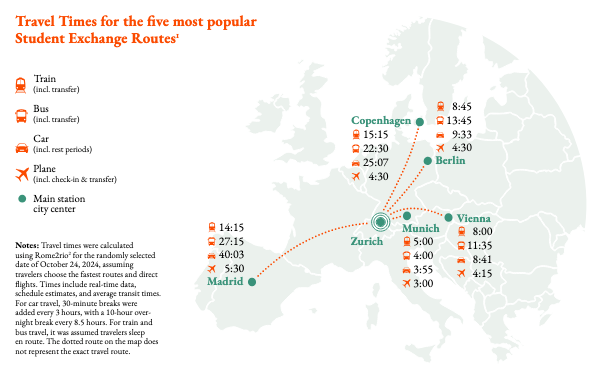
Source: University of Zurich & European University Foundation. (2025). SET Connectivity Reports. Zenodo.
The missing piece: Infrastructure
For an Erasmus+ student today, the reality lies in structural limitations, not just motivational ones.
Recent developments indicate growing momentum for rail travel on the EU’s agenda. The Commission’s recently published Passenger Package can improve passenger rights protections and make international rail travel more accessible and easy to organise. It promises a single centralised platform and booking made in a single transaction, as well as protections in case of a missed connection, including the possibility to reroute and receive compensation.
If these promises are fulfilled, every student and citizen should be able to enjoy simpler, more integrated booking systems, cheaper night-train options, and protection of their passenger rights.
Changing the paradigm
Recognising that the outbound trip to the mobility destination is part of the educational experience. Green travel can be so much more than merely going from place A to B; it has the potential to strengthen multiple transversal competencies and lifelong skills, such as planning your trip, meeting new friends along the way, adapting to disruptions, and fostering a curious, open-minded attitude. We mapped this potential in the SET Green Competencies Repository and visualised it in an interactive board game. Even more so, as an informal learning experience, it merits validation by HEIs in more or less formal ways. Ultimately, this is what Erasmus+ stands for, one of the most popular and symbolic European initiatives: experiencing another country, culture, language, and way of learning and living.
What the next Erasmus+ programme needs
We now know the challenges and enabling factors for delivering the Erasmus+ programme’s green priority and addressing its biggest elephant in the room: carbon footprint. It is no longer a question of whether students want to choose ground travel or how HEIs should support it. The SET project clearly demonstrated what needs to happen and where the opportunities lie.
In preparation for the next programme period, it is both an opportunity and our responsibility to connect all these efforts into a coherent system that promotes sustainable travel from start to finish. Rendering ground transportation the default is much more than reducing carbon emissions (though this is an ambitious and existential goal that should not be understated); it can elevate the quality and meaning of international student mobility, underpinning the fundamental EU values of connectedness, accessibility, inclusiveness, and solidarity.